Another year down the tubes, another year beginning. While I tend to focus on the negative, I am also hopeful that the coming year has the potential to see many positive things happen in the world. I only wish that we in the U.S. of A. had some real leadership.
Our dear President Bush has been talking about "a new way forward." This phrase should actually be in caps because it is his latest slogan (the man loves slogans). The world is anxiously awaiting his message about The New Way Forward in Iraq - I'm not holding my breath.
But Bush gave us a hint of what he's thinking at a recent press conference (might have been December 20th). Here are his words:
As we work with Congress in the coming year to chart a new course in Iraq and strengthen our military to meet the challenges of the 21st century, we must also work together to achieve important goals for the American people here at home. This work begins with keeping our economy growing. … And I encourage you all to go shopping more.
You all certainly remember that this was also his advice to us following the September 11 attacks. Go shopping! The Bush M.O. is very clear - spend, spend, spend. "Strengthen our military" in the above statement translates to "we're going to spend a lot more money on the military" - the cost of the Iraq war is now at $2 billion per week (see footnote). "Meet the challenges of the 21st century" means figuring out new ways for consumers to spend more so Bush's supporters (puppet masters?) can reap even larger obscene profits than they already are (have you read about the record CEO compensation packages in 2006?).
The implications of the Bush "go shopping/spend" policy are very far-reaching. An excellent article by Anatol Lieven discusses the relationship between global warming and western free-market democracy - an important read. A previous post of mine discussed the relationship between American consumerism and global air pollution from China. So don't be fooled by G.W. Bush's down-home folksiness - this is bad shit, and generations to come in the USA and around the globe will be paying for it!
Bye bye '06 - buy buy '07!
Footnote: The number $2 billion is difficult to grasp. Think of it this way - if you are fortunate enough to make a salary of $100,000 per year, it would only take you 20,000 years to earn $2 billion.

Whatever is on my mind: politics, the news, philosophy, poetry and satire. VISIT MY WEBSITE (click on The Some Times button, below) PRIVACY NOTICE/GDPR: SEE JAN. 4, 2019
Sunday, December 31, 2006


Thursday, December 28, 2006
REPORT TO GRAND COUNCIL OF SCIENCE FROM INVESTIGATOR QZRKSTYNLPTYR
TECHNICAL MEMORANDUM OF INVESTIGATION
TO: Grand Council of Science
FROM: Investigator Qzrkstynlptyr (8i4412121212zpq)
SUBJECT: Investigation of Planet Blue Liquid (S+3): Preliminary Life Form Observations
Council Members:
I respectfully submit this report as per my investigative assignment under the Inter-Planetary Scientific Survey Protocols of 0695534, Section a666, Sub-x. Since my recent arrival on the Planet Blue Liquid 14 parmuns ago, I have spent considerable time conducting non-contact, non-visible observations to determine which life forms are dominant and potentially approachable. This report summarizes my initial observations of the apparent dominant life form on this planet, which I shall refer to as Life Form D06 (LFD06).
I selected as the setting for my first contact an area known as a "park," based on my observations that the dominant life form frequents these areas regularly. Curiously, all of these creatures bring with them to the park area another life form, which I have coded as LFH8, with which they have a peculiar relationship. Each individual LFD06 in the park area is pulling one specimen of LFH8 by means of a length of material, often a synthetic or hide strap. LFD06 has a loop of material around the area between its head and trunk to which the length of strap is attached; LFH8 appears to be grasping a loop in the other end of the strap in one of its two articulated upper appendages.
I should describe here that LFD06 is a quadra-pedal life form, while LFH8 is typically bi-pedal, but has a second set of appendages with articulated endings with which it manipulates objects. LFD06 is fur-covered over the entirety of its body; LFH8 typically has scant fur except on the head, although many males of the species have much less fur even in that location.
After considerable study of these organisms, I have determined the following behavioral patterns:
1. LFD06 is dominant, and pulls LFH8 behind it, sometimes with great effort, along pathways, through shrubbery, and under trees.
2. LFD06 constantly inhales through special openings in its head as if sampling the air, particularly close to the ground and on vertical objects.
3. LFD06 stops frequently to void liquid, and occasionally to deposit solid material on the ground.
4. LFH8 uses a thin plastic membrane pouch to collect the solid material deposited by LFD06 and transports it for the remainder of the travel through and out of the park area.
My conclusions thus far concerning these behaviors are: a) LFH8 is subservient to LFD06; b) LFD06 has trained LFH8 to follow specific behavioral commands, although LFH8 sometimes exhibits resistance, particularly when being pulled by a strap; c) LFH8 values the solid material deposited on the ground by LFD06 (perhaps as food??), and collects and carries this material with it.
The next phase of my investigation will be to attempt contact with an individual LFD06. I have many questions about this life form, including its relationship with, and apparent tolerance of, the less intelligent LFH8.
Until my next report.
May your quarks flow randomly; may the nebulae align favorably; and may the interests of galactic study always be foremost in your active neurons.
Investigator Qzrkstynlptyr
TO: Grand Council of Science
FROM: Investigator Qzrkstynlptyr (8i4412121212zpq)
SUBJECT: Investigation of Planet Blue Liquid (S+3): Preliminary Life Form Observations
Council Members:
I respectfully submit this report as per my investigative assignment under the Inter-Planetary Scientific Survey Protocols of 0695534, Section a666, Sub-x. Since my recent arrival on the Planet Blue Liquid 14 parmuns ago, I have spent considerable time conducting non-contact, non-visible observations to determine which life forms are dominant and potentially approachable. This report summarizes my initial observations of the apparent dominant life form on this planet, which I shall refer to as Life Form D06 (LFD06).
I selected as the setting for my first contact an area known as a "park," based on my observations that the dominant life form frequents these areas regularly. Curiously, all of these creatures bring with them to the park area another life form, which I have coded as LFH8, with which they have a peculiar relationship. Each individual LFD06 in the park area is pulling one specimen of LFH8 by means of a length of material, often a synthetic or hide strap. LFD06 has a loop of material around the area between its head and trunk to which the length of strap is attached; LFH8 appears to be grasping a loop in the other end of the strap in one of its two articulated upper appendages.
I should describe here that LFD06 is a quadra-pedal life form, while LFH8 is typically bi-pedal, but has a second set of appendages with articulated endings with which it manipulates objects. LFD06 is fur-covered over the entirety of its body; LFH8 typically has scant fur except on the head, although many males of the species have much less fur even in that location.
After considerable study of these organisms, I have determined the following behavioral patterns:
1. LFD06 is dominant, and pulls LFH8 behind it, sometimes with great effort, along pathways, through shrubbery, and under trees.
2. LFD06 constantly inhales through special openings in its head as if sampling the air, particularly close to the ground and on vertical objects.
3. LFD06 stops frequently to void liquid, and occasionally to deposit solid material on the ground.
4. LFH8 uses a thin plastic membrane pouch to collect the solid material deposited by LFD06 and transports it for the remainder of the travel through and out of the park area.
My conclusions thus far concerning these behaviors are: a) LFH8 is subservient to LFD06; b) LFD06 has trained LFH8 to follow specific behavioral commands, although LFH8 sometimes exhibits resistance, particularly when being pulled by a strap; c) LFH8 values the solid material deposited on the ground by LFD06 (perhaps as food??), and collects and carries this material with it.
The next phase of my investigation will be to attempt contact with an individual LFD06. I have many questions about this life form, including its relationship with, and apparent tolerance of, the less intelligent LFH8.
Until my next report.
May your quarks flow randomly; may the nebulae align favorably; and may the interests of galactic study always be foremost in your active neurons.
Investigator Qzrkstynlptyr
Monday, December 25, 2006
THE FINEST STRUCTURE CAN HOUSE THE WORST EVIL
"The finest structure can house the worst evil." This was the message inside my fortune cookie today at our neighborhood Chinese restaurant. (I searched the internet for the origin of this saying - all I could find was a lot of other people who had the same message inside their fortune cookies also wondering who said it!) I'm a big fan of fortune cookie wisdom; I have often received sayings that had a particular relevance to my life or my thoughts. This one, received on Christmas Day, is no exception.
I've been thinking a lot lately about the capacity of human beings to perpetrate evil. A headline today about world leaders calling for peace, on Christmas Day, urged me to write about this topic. In many ways, the human animal is "the finest structure," a result of millions of years of evolution (obviously I'm not a creationist). Humans have an intellectual and creative capability that is, as far as we know, superior to any other living organisms on Earth. Part of this superiority is the ability to recognize and distinguish between "good" and "evil" (these words are in quotes because I don't want to even try to define them - I'll leave that to you). But throughout history humans have committed what can only be termed "evil" acts against other humans. A quick trip around the world today finds terrorism, genocide, occupation, torture, bigotry, humiliation, and other actions in every corner. History repeats, and we humans never seem to learn from history. Why?
On a recent "Journey of Peace" to Israel and Palestine, we met with Sari Nusseibeh, a Palestinian, philosopher, and the President of Al Quds University in East Jerusalem. I recently read one of Dr. Nusseibeh's presentations, “Identities in conflict: Masters and Slaves,” given at the International Conference of the Human Development Capability Association in Netherlands, September 2006. His discussion of human identity is very relevant to my questions about evil among humans. Dr. Nusseibeh talks about the "wide range of identity-layers, or layers which together make up or constitute an identity." In other words, each of us has multiple factors which together constitute our identity. Each individual, however, manifests an identity to those around him or her, and the choice of identity is "the degree to which one is a master or slave of one’s identity - a degree which can be taken to be at once a measure of one’s freedom, as well as a function of the propensity to prejudice-propelled conflict or violence."
It is the choice of identity that I believe is the key to understanding the manifestations of evil by humans. Dr. Nusseibeh states that "to the extent that one can make those choices one can be said to be master of one’s identity; and to the extent that one particular layer comes to dominate and in an exclusivist manner therefore to limit one’s choices one’s capability range, or freedom, is diminished, thereby reflecting the transformation of the agent from being master to being a slave of their identity." Do we as individuals consciously choose our identities, or do we allow external factors, including other people, to choose our identities for us? "Are we destined, as human beings, to be victims of our self-prejudiced identities?" Do we make excuses for our own behaviors by blaming the behaviors of others? "If we admit we have been turned into monsters only by the violent actions perpetrated by the other side, what else should we expect to find on the other side as we carry out similar actions but monsters, too."
As "the finest structure," we as humans can choose our identities; we can choose to reject evil and promote good. Humans also have the capacity to teach and learn - we are not just biologically programmed to act out the same behaviors over and over. "Being able to master sufficiently one’s identity, and to shape it, can be a powerful tool in helping shape the identities of others."
My identity as an American is seen by many in the world as the identity projected by the actions of my government, many of which I presently do not support. It is my goal, therefore, to actively choose and present an identity that is aligned with my core values and beliefs. And, while I often find it difficult to maintain a positive attitude about the world and the actions of my fellow humans (read some of my blog posts), I know that I must continue to focus my self-identity on the parts of my humanity that are "good," all the while rejecting "evil" and speaking out against it.
The finest structures can house the worst evil. But the finest structures can also house the greatest good. There are many good people on this planet, and we need to tell their stories more often as examples for hope. The choice between good and evil is ours - each of us - and I still, despite the evil rampant in the world, trust in the true goodness of humanity.
I've been thinking a lot lately about the capacity of human beings to perpetrate evil. A headline today about world leaders calling for peace, on Christmas Day, urged me to write about this topic. In many ways, the human animal is "the finest structure," a result of millions of years of evolution (obviously I'm not a creationist). Humans have an intellectual and creative capability that is, as far as we know, superior to any other living organisms on Earth. Part of this superiority is the ability to recognize and distinguish between "good" and "evil" (these words are in quotes because I don't want to even try to define them - I'll leave that to you). But throughout history humans have committed what can only be termed "evil" acts against other humans. A quick trip around the world today finds terrorism, genocide, occupation, torture, bigotry, humiliation, and other actions in every corner. History repeats, and we humans never seem to learn from history. Why?
On a recent "Journey of Peace" to Israel and Palestine, we met with Sari Nusseibeh, a Palestinian, philosopher, and the President of Al Quds University in East Jerusalem. I recently read one of Dr. Nusseibeh's presentations, “Identities in conflict: Masters and Slaves,” given at the International Conference of the Human Development Capability Association in Netherlands, September 2006. His discussion of human identity is very relevant to my questions about evil among humans. Dr. Nusseibeh talks about the "wide range of identity-layers, or layers which together make up or constitute an identity." In other words, each of us has multiple factors which together constitute our identity. Each individual, however, manifests an identity to those around him or her, and the choice of identity is "the degree to which one is a master or slave of one’s identity - a degree which can be taken to be at once a measure of one’s freedom, as well as a function of the propensity to prejudice-propelled conflict or violence."
It is the choice of identity that I believe is the key to understanding the manifestations of evil by humans. Dr. Nusseibeh states that "to the extent that one can make those choices one can be said to be master of one’s identity; and to the extent that one particular layer comes to dominate and in an exclusivist manner therefore to limit one’s choices one’s capability range, or freedom, is diminished, thereby reflecting the transformation of the agent from being master to being a slave of their identity." Do we as individuals consciously choose our identities, or do we allow external factors, including other people, to choose our identities for us? "Are we destined, as human beings, to be victims of our self-prejudiced identities?" Do we make excuses for our own behaviors by blaming the behaviors of others? "If we admit we have been turned into monsters only by the violent actions perpetrated by the other side, what else should we expect to find on the other side as we carry out similar actions but monsters, too."
As "the finest structure," we as humans can choose our identities; we can choose to reject evil and promote good. Humans also have the capacity to teach and learn - we are not just biologically programmed to act out the same behaviors over and over. "Being able to master sufficiently one’s identity, and to shape it, can be a powerful tool in helping shape the identities of others."
My identity as an American is seen by many in the world as the identity projected by the actions of my government, many of which I presently do not support. It is my goal, therefore, to actively choose and present an identity that is aligned with my core values and beliefs. And, while I often find it difficult to maintain a positive attitude about the world and the actions of my fellow humans (read some of my blog posts), I know that I must continue to focus my self-identity on the parts of my humanity that are "good," all the while rejecting "evil" and speaking out against it.
The finest structures can house the worst evil. But the finest structures can also house the greatest good. There are many good people on this planet, and we need to tell their stories more often as examples for hope. The choice between good and evil is ours - each of us - and I still, despite the evil rampant in the world, trust in the true goodness of humanity.
Friday, December 15, 2006
HECKUVA JOB RUMMIE!!
On December 16, 2006, President George W. Bush praised outgoing Secretary of Defense Donald Rumsfeld in a farewell ceremony. According to the President:
Don Rumsfeld has been at my side from the moment I took office. We've been through war together. We have shared some of the most challenging moments in our nation's history. Over the past six years, I have come to appreciate Don Rumsfeld's professionalism, his dedication, his strategic vision, his deep devotion to the men and women of our nation who wear the uniform, and his love for the United States of America.
Well, I suppose it would be a bit tacky for the President to actually tell the truth about Rummie, so I'll do Mr. Bush a favor and do the dirty work for him.
"I would not say that the future is necessarily less predictable than the past - I think the past was not predictable when it started." Donald Rumsfeld
Heckuva job, Rummie!!
Click here for these quotes and more.
Don Rumsfeld has been at my side from the moment I took office. We've been through war together. We have shared some of the most challenging moments in our nation's history. Over the past six years, I have come to appreciate Don Rumsfeld's professionalism, his dedication, his strategic vision, his deep devotion to the men and women of our nation who wear the uniform, and his love for the United States of America.
Well, I suppose it would be a bit tacky for the President to actually tell the truth about Rummie, so I'll do Mr. Bush a favor and do the dirty work for him.
- Don Rumsfeld's professionalism: "Needless to say, the President is correct. Whatever it was he said." Donald Rumsfeld
- Don Rumsfeld's strategic vision: "Stuff happens. It's untidy, and freedom's untidy, and free people are free to make mistakes and commit crimes and do bad things." Donald Rumsfeld
- more strategic vision: "The Gulf war in the 1990s lasted five days on the ground. I can't tell you if the use of force in Iraq today would last five days, or five weeks, or five months. But it certainly isn't going to last any longer than that." Donald Rumsfeld
- Don Rumsfeld's deep devotion to the men and women of our nation who wear the uniform: "You go to war with the army you have, not the army you might want or wish to have at a later time." Donald Rumsfeld
- a combination of strategic vision (military) and devotion to our people in uniform: "We know where they (WMD) are. They're in the area around Tikrit and Baghdad and east, west, south and north somewhat." Donald Rumsfeld
- another combo, as above: "We do know of certain knowledge that he [Osama Bin Laden] is either in Afghanistan, or in some other country, or dead." Donald Rumsfeld
- "If we left Iraq prematurely, the enemy would tell us to leave Afghanistan and then withdraw from the Middle East. And if we left the Middle East, they’d order us and all those who don’t share their militant ideology to leave what they call the occupied Muslim lands from Spain to the Philippines." Donald Rumsfeld
- "Reports that say that something hasn't happened are always interesting to me, because as we know, there are known knowns; there are things we know we know. We also know there are known unknowns; that is to say we know there are some things we do not know. But there are also unknown unknowns - the ones we don't know we don't know." Donald Rumsfeld
"I would not say that the future is necessarily less predictable than the past - I think the past was not predictable when it started." Donald Rumsfeld
Heckuva job, Rummie!!
Click here for these quotes and more.
Wednesday, December 13, 2006
DEAR PRESIDENT AHMADINEJAD
Sir: Based upon knowing your keen interest in history and the fairness of historical representation, as evidenced by your recent international conference: "Review of the Holocaust: Global Vision," I would like to invite you to a newly announced international conference: "Review of Iranian Whining: Global Historic Revisionism." This conference will examine the truth behind claims by the Iranian people about their history, and reveal many interesting, and sometimes startling, actual facts.
A recent American television propaganda piece about Iran by the Jewish journalist Ted Koppel (whose parents did not escape from Nazi Germany - this is another great lie) included numerous supposedly Iranian people reminding Mr. Koppel that in 1953 the United States had overthrown the democratically-elected Prime Minister of Iran and replaced him with the Dictator, Shah Reza Khan, a puppet of the U.S. The international conference will expose this fraudulent myth for what it is - a fraudulent myth. Iran never had a democratically elected Parliament and Prime Minister; the United States did not overthrow this supposed Prime Minister and put him in jail and house arrest for the remainder of his life; and there never was a Shah Reza Khan - this is one of the Big Lies promulgated by the Iranian people, who are opposed to truth as history (they should be wiped from the map)!
Similarly, there are those among the population of Iran, and other countries I might add, who claim that there was a long war between Iraq and Iran between 1980 and 1988. These same false-witnesses to history also claim, among other lies, that Iraq used chemical weapons against Iranian troops, that some Iranian prisoners of war were not returned until 2003, and - the biggest fabrication of all - that the United States was complicit in its support of Saddam Hussein of Iraq. The infamous photo of the smiling Donald Rumsfeld shaking hands with Saddam Hussein is obviously a photo-shopped fake!
So, Dear President Ahmadinejad, please accept this invitation to our international conference as the Keynote Speaker. Your presence will lend immeasurable legitimacy to this event as a gathering of committed individuals (or those who should be committed). Please tailor your keynote address to the following topic: "History and Truth: Ramblings of a Madman."
Thank you.
A recent American television propaganda piece about Iran by the Jewish journalist Ted Koppel (whose parents did not escape from Nazi Germany - this is another great lie) included numerous supposedly Iranian people reminding Mr. Koppel that in 1953 the United States had overthrown the democratically-elected Prime Minister of Iran and replaced him with the Dictator, Shah Reza Khan, a puppet of the U.S. The international conference will expose this fraudulent myth for what it is - a fraudulent myth. Iran never had a democratically elected Parliament and Prime Minister; the United States did not overthrow this supposed Prime Minister and put him in jail and house arrest for the remainder of his life; and there never was a Shah Reza Khan - this is one of the Big Lies promulgated by the Iranian people, who are opposed to truth as history (they should be wiped from the map)!
Similarly, there are those among the population of Iran, and other countries I might add, who claim that there was a long war between Iraq and Iran between 1980 and 1988. These same false-witnesses to history also claim, among other lies, that Iraq used chemical weapons against Iranian troops, that some Iranian prisoners of war were not returned until 2003, and - the biggest fabrication of all - that the United States was complicit in its support of Saddam Hussein of Iraq. The infamous photo of the smiling Donald Rumsfeld shaking hands with Saddam Hussein is obviously a photo-shopped fake!
So, Dear President Ahmadinejad, please accept this invitation to our international conference as the Keynote Speaker. Your presence will lend immeasurable legitimacy to this event as a gathering of committed individuals (or those who should be committed). Please tailor your keynote address to the following topic: "History and Truth: Ramblings of a Madman."
Thank you.
Sunday, December 03, 2006
ISRAEL - PALESTINE: LIFE IN A HARSH LANDSCAPE
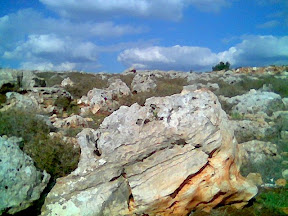
I've developed a habit of studying landscapes as I travel the world. By "studying" I mean not just seeing landscapes as they roll by, but sensing their realities of geology, ecology, and human use. As we've traveled through Israel and Palestine (the West Bank), I've internalized a deep sense of the harshness of the landscape. With the exception of the coastal plain of the Mediterranean Sea, most of what I've seen in those lands is a beautiful, but harsh landscape of desert and rock.
Several years ago we drove the road from Tiberius in the north, south to the Dead Sea and then west to Jerusalem. The highway generally parallels the Jordan Valley, which is seen below as a green ribbon at the boundary of Israel and Jordan. But the more immediate landscape is desert sand and rock - hot, dry and with a sense of unforgiving. We passed small towns and individual dwellings, and imagined the effort needed to scratch out a living from this land.
This year we traveled into northern Israel again, to the area between Haifa and Tiberius, where we have family in the city of Carmiel. This landscape is dominated by rock, as pictured above. As I walked through an undeveloped area on the edge of town to take pictures, even the thorny plants reminded me that this landscape can be unforgiving. The rock itself is old and weathered, appearing ancient like everything else in this land. What stories could the rock relate if I could only find its language?
People occupy landscapes, and often change them to suite their needs. Forests disappear, grasslands yield to pasture and row crops, cities grow where nature once ruled. But there is something about the landscape of Israel/Palestine that conveys the sense that nature rules here. Perhaps the harshness of civilization in this land, the seemingly endless conflicts between Israelis and Palestinians, Arabs (Muslims and Christians) and Jews, Muslims and Christians, is a reflection of the land itself.
For millenia, people have learned to live with and on the harsh landscape of these lands, to accept the land for what it is and reach an accord with it. My hope is that someday people can learn to live with each other, to reach an accord with the social and political landscape and turn its harshness into peace.
Thursday, November 30, 2006
AND THE WINNER IS......MERRY CHRISTMAS!!
Yes, dear readers, it's true, Merry Christmas seems to have won "the War on Christmas." If you remember, 2005 was the year that the Christian right declared that they were doing holy battle against the evil-doers who were waging a War on Christmas. Who were these evil-doers? People like me, and many others who were simply saying "Happy Holidays" to friends and family who do not celebrate Christmas because - well gosh - they aren't Christian! Many retail businesses were also using "Happy Holidays" displays and advertising to attract consumers of all religious beliefs. And many people, myself included, objected to religious displays on public property, such as courthouse lawns.
"JUST SAY MERRY CHRISTMAS" was the rallying cry of the Christian right, and they crusaded mightily against the heathens among us who would object. Separation of church and State - bah humbug!
The 2006 holiday season is upon us - I'm sure you've noticed. And guess what? It looks like Merry Christmas is the winner. Every advertisement by Target stores for a recent major national television program was a Merry Christmas advertisement. "Merry Christmas" ads and banners have sprouted everywhere in retail land. Starbucks is once again selling their Christmas Blend, but try to find a bag of the Holiday Blend and you'll be very disappointed, even though the Starbucks staff will tell you that they're supposed to have the blue bags and labels for the same beans that are in the red bags. A very reliable source at Starbucks tells the following story: a customer asked what the diference is between the coffee in the red Christmas Blend bags and the blue Holiday Blend bags (it seems some stores have the blue bags). The Starbucks person explained that it is the same coffee, just in different bags. "Oh, I get it," replied the customer, "the blue bags are for Jewish people, and the red bags are for Americans!"
Just say "Merry Christmas."
"JUST SAY MERRY CHRISTMAS" was the rallying cry of the Christian right, and they crusaded mightily against the heathens among us who would object. Separation of church and State - bah humbug!
The 2006 holiday season is upon us - I'm sure you've noticed. And guess what? It looks like Merry Christmas is the winner. Every advertisement by Target stores for a recent major national television program was a Merry Christmas advertisement. "Merry Christmas" ads and banners have sprouted everywhere in retail land. Starbucks is once again selling their Christmas Blend, but try to find a bag of the Holiday Blend and you'll be very disappointed, even though the Starbucks staff will tell you that they're supposed to have the blue bags and labels for the same beans that are in the red bags. A very reliable source at Starbucks tells the following story: a customer asked what the diference is between the coffee in the red Christmas Blend bags and the blue Holiday Blend bags (it seems some stores have the blue bags). The Starbucks person explained that it is the same coffee, just in different bags. "Oh, I get it," replied the customer, "the blue bags are for Jewish people, and the red bags are for Americans!"
Just say "Merry Christmas."
Saturday, November 25, 2006
CHINA AND GLOBAL POLLUTION: EACH OF US IS RESPONSIBLE
The Oregonian ran a front page article yesterday about huge clouds of soot and mercury drifting across the Pacific to Oregon and the rest of the United States. Major sources of this pollution are the coal-powered electrical generating plants in China. China presently has about 2,000 coal-fired plants, and has plans in place to build another 500. Impacts in Oregon of these Chinese plumes include hazy skies, increased particulate matter in our air, and increased levels of mercury in our rivers, leading to increased mercury levels in fish.
I've written previously in this blog about the basic laws of ecology, as posed in the 1970's by Dr. Barry Commoner, including "everything is connected to everything else." There are direct links between the Chinese air pollution and each Oregonian. I'm sure that like me, you've often noticed that almost everything we buy these days is made in China. Chinese manufacturers provide low cost labor, low cost materials, and an aggressive manufacturing and exporting sector based on scant government regulation regarding worker health and welfare, environmental impact (i.e. pollution), and other issues that increase the cost of goods made in the U.S.A. As a result, the Chinese economy is a raging tiger, trying to keep up with both the foreign demand for manufactured goods, and the domestic demand for modernity and a higher standard of living (in other words, the Chinese want to be like us Americans).
I pulled some data from the U.S. Bureau of Census web site about the balance of trade between China and the United States. Below is a graph of the data I pulled (sorry about the quality - I really struggled to import this as a graphic). The graph shows, for every year from 1985 until 2006, the dollar values of goods exported from the USA to China (blue line), imported from China to the USA (red line), and the trade balance, or difference between the import and export (yellow line). The vertical axis is millions of dollars, and the values shown on the axis are therefore $100 billion, $200 billion, etc.

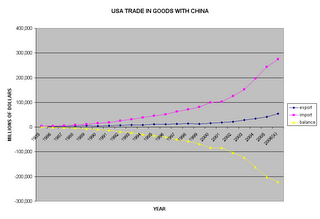
In 1985, the US exported $3.85 billion and imported $3.86 billion in goods. By 1995, the US exported $11.7 billion and imported $45.5 billion. By 2005, the US exported $41.9 billion and imported $243.5 billion of goods from China. The trade balance (US exports to China minus US imports from China) went from minus $6 million in 1985, to minus $33.7 billion in 1995, to minus $201.5 billion in 2005, and is projected to be about minus $221.7 billion in 2006. Household and electronic goods account for a major portion of the imports from China.
Yesterday was the day after the Thanksgiving holiday in America, and is always the biggest shopping day of the year. Stores open at 5 and 6AM with big sales, and people line up to be there early. The TV news showed shoppers with carts full of big-screen televisions, video games, stereo and video equipment, and all manner of electronics and toys and household items, mostly bought on credit (US consumer credit debt is another topic). A majority of these consumer goods are probably manufactured in China.
Everything is connected to everything else. The pollution drifting through the atmosphere from China to Oregon is directly linked to the buying habits of American consumers. We want our "stuff," and we don't really think or care about where it comes from - we only want it at a low price. Unfortunately, the dollar price we pay at the store is not the true price of the item. The true price includes the ecological price tag that comes - hidden - with each item we buy.


I've written previously in this blog about the basic laws of ecology, as posed in the 1970's by Dr. Barry Commoner, including "everything is connected to everything else." There are direct links between the Chinese air pollution and each Oregonian. I'm sure that like me, you've often noticed that almost everything we buy these days is made in China. Chinese manufacturers provide low cost labor, low cost materials, and an aggressive manufacturing and exporting sector based on scant government regulation regarding worker health and welfare, environmental impact (i.e. pollution), and other issues that increase the cost of goods made in the U.S.A. As a result, the Chinese economy is a raging tiger, trying to keep up with both the foreign demand for manufactured goods, and the domestic demand for modernity and a higher standard of living (in other words, the Chinese want to be like us Americans).
I pulled some data from the U.S. Bureau of Census web site about the balance of trade between China and the United States. Below is a graph of the data I pulled (sorry about the quality - I really struggled to import this as a graphic). The graph shows, for every year from 1985 until 2006, the dollar values of goods exported from the USA to China (blue line), imported from China to the USA (red line), and the trade balance, or difference between the import and export (yellow line). The vertical axis is millions of dollars, and the values shown on the axis are therefore $100 billion, $200 billion, etc.
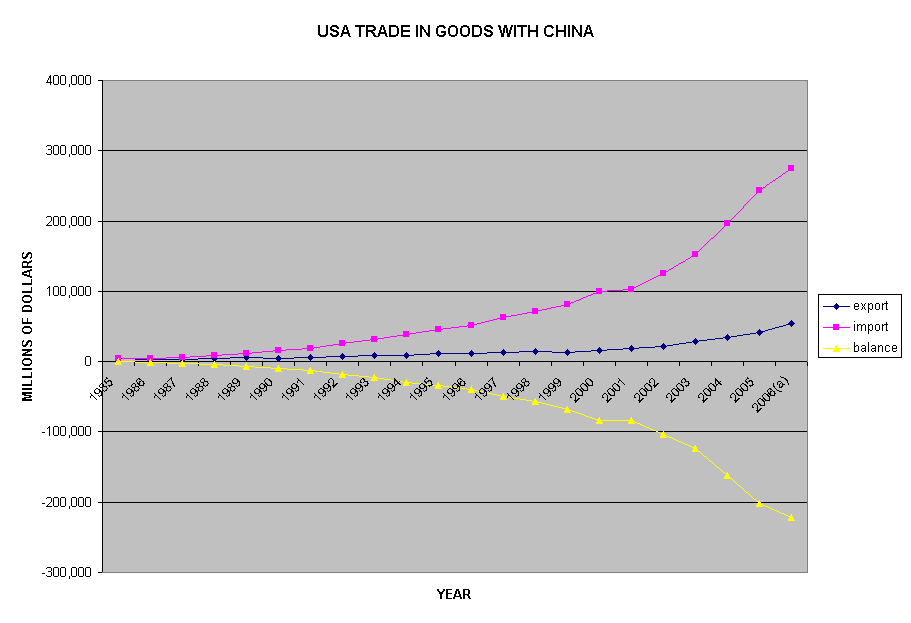
In 1985, the US exported $3.85 billion and imported $3.86 billion in goods. By 1995, the US exported $11.7 billion and imported $45.5 billion. By 2005, the US exported $41.9 billion and imported $243.5 billion of goods from China. The trade balance (US exports to China minus US imports from China) went from minus $6 million in 1985, to minus $33.7 billion in 1995, to minus $201.5 billion in 2005, and is projected to be about minus $221.7 billion in 2006. Household and electronic goods account for a major portion of the imports from China.
Yesterday was the day after the Thanksgiving holiday in America, and is always the biggest shopping day of the year. Stores open at 5 and 6AM with big sales, and people line up to be there early. The TV news showed shoppers with carts full of big-screen televisions, video games, stereo and video equipment, and all manner of electronics and toys and household items, mostly bought on credit (US consumer credit debt is another topic). A majority of these consumer goods are probably manufactured in China.
Everything is connected to everything else. The pollution drifting through the atmosphere from China to Oregon is directly linked to the buying habits of American consumers. We want our "stuff," and we don't really think or care about where it comes from - we only want it at a low price. Unfortunately, the dollar price we pay at the store is not the true price of the item. The true price includes the ecological price tag that comes - hidden - with each item we buy.
Friday, November 17, 2006
TELLTALE SIGNS THAT WE'RE HOSED
Maybe I tend to be too cynical, but, as Lily Tomlin said: "no matter how cynical I get, I just can't keep up." I know that the media tends to focus on negative news, and that good things are happening in some places; but everywhere I look there are telltale signs that human civilization is hosed. A few examples from the recent headlines:
- In 2005, 35.1 million people in the United States were "food insecure" (a government term for spinning the term "hungry"), meaning that they didn't have enough food for an active, healthy life.
- The number of Oregon school children who are homeless increased by 16% last year compared to the previous year, to a total of 13,159.
- Siberian bears are not hibernating, Arctic sea ice is at very low levels, Arctic sea temperatures are warmer than historically, shrubs are taking over large areas of Arctic tundra, and permafrost isn't very "perma" anymore - all signs of global warming.
- The Deputy Ambassador of the United Kingdom is traveling through California, Oregon and Washington looking for state and municipal partners to combat global warming. The British have given up looking to the Bush White House for leadership on this issue.
- President George W. Bush thinks that the U.S. A. can win the Iraq war if "we don't quit" like we did in Viet Nam.
- Genocide continues unabated in Darfur as the world watches.
- The U.S. foreign policy in relation to nations such as Iran and North Korea is to call them names, refuse to talk to them, and crank up the machines of war.
- Israel and Hamas continue to throw explosives at each other.
- And finally, people are camping on the sidewalks in front of retail stores - for days - in order to purchase the new $600 Playstation 3 video game console.
Friday, November 03, 2006
WHAT CAN BE DONE ABOUT IRAN?
OK, now that I've ruled out the role of god in dealing with Iran (see my previous post), does that mean people should do nothing? Certainly not. (As an aside, our Israeli cousin, after reading my letter in the Jerusalem Post, said that she agrees with me - George Bush is not god's operative who has been willed to destroy Iran - but her take is that god should bomb Iran!)
The Israeli Prime Minister yesterday chastised the world community for not being tough with Iran, and for being too slow to do so. Israel is rightly concerned about Iranian moves towards nuclearity (a term I just invented), considering: 1) Iran's announced intention to develop nuclear weapons, 2) the Iranian President's continuing declarations that the Holocaust was a fake, 3) the Iranian President's stated goals of wiping Israel off the map, and 4) the televised tests by Iran yesterday of missles capable of delivering warheads to Israel.
I'm certainly not a statesman or a diplomat, and I won't pretend to be one. I also don't think we can change the direction Iran is taking by saying "pretty please don't" or something like that. But I can't accept a military response as the first response. Israeli Prime Minister Olmert is, in my opinion, justified in criticizing the international community for moving too slowly on this threat. The world community, including the NATO countries, China and Russia, as well as many others, need to take a very strong and very vocal stand against Iran's moves towards nuclearity. Economic moves should be clearly designed to hurt Iran in the pocket book (and I don't mean by starving the Iranian people), and diplomatic moves should be designed to isolate Iran as a country moving in a dangerous direction.
But - and this is a major but - channels of communication with Iran should be kept open, and new channels developed to move towards agreement on basic principles. Unfortunately, the United States does not operate this way under Geaorge Bush. Instead, the U.S. administration uses name-calling (Axis of Evil) and threats of war to try to bully our "enemies" into submission. The foreign policy of the United States is a simple one - no policy at all, and don't talk to people we don't like. Every action gets a reaction. And the U.S. President has not made and kept friends around the world who are eager to stand with us; instead, Bush has pissed-off many governments around the world, and not built bridges of understanding and cooperation. Do I think Bush is the problem vis-a-vis Iran? No, but he has made matters worse in a very short time.
Let's not kid ourselves, Iran is a direct threat to Israel, the Middle East, and world stability. If the rest of the world diddles around too long, Iran might do something stupid, which will have very dire consequences for large numbers of people and for global relations. Maybe they want that to happen (they being the present rulers of Iran). So my message to all you world leaders who are regular readers of my blog is: do something now before it's too late.
The Israeli Prime Minister yesterday chastised the world community for not being tough with Iran, and for being too slow to do so. Israel is rightly concerned about Iranian moves towards nuclearity (a term I just invented), considering: 1) Iran's announced intention to develop nuclear weapons, 2) the Iranian President's continuing declarations that the Holocaust was a fake, 3) the Iranian President's stated goals of wiping Israel off the map, and 4) the televised tests by Iran yesterday of missles capable of delivering warheads to Israel.
I'm certainly not a statesman or a diplomat, and I won't pretend to be one. I also don't think we can change the direction Iran is taking by saying "pretty please don't" or something like that. But I can't accept a military response as the first response. Israeli Prime Minister Olmert is, in my opinion, justified in criticizing the international community for moving too slowly on this threat. The world community, including the NATO countries, China and Russia, as well as many others, need to take a very strong and very vocal stand against Iran's moves towards nuclearity. Economic moves should be clearly designed to hurt Iran in the pocket book (and I don't mean by starving the Iranian people), and diplomatic moves should be designed to isolate Iran as a country moving in a dangerous direction.
But - and this is a major but - channels of communication with Iran should be kept open, and new channels developed to move towards agreement on basic principles. Unfortunately, the United States does not operate this way under Geaorge Bush. Instead, the U.S. administration uses name-calling (Axis of Evil) and threats of war to try to bully our "enemies" into submission. The foreign policy of the United States is a simple one - no policy at all, and don't talk to people we don't like. Every action gets a reaction. And the U.S. President has not made and kept friends around the world who are eager to stand with us; instead, Bush has pissed-off many governments around the world, and not built bridges of understanding and cooperation. Do I think Bush is the problem vis-a-vis Iran? No, but he has made matters worse in a very short time.
Let's not kid ourselves, Iran is a direct threat to Israel, the Middle East, and world stability. If the rest of the world diddles around too long, Iran might do something stupid, which will have very dire consequences for large numbers of people and for global relations. Maybe they want that to happen (they being the present rulers of Iran). So my message to all you world leaders who are regular readers of my blog is: do something now before it's too late.
Thursday, November 02, 2006
WITH GOD ON OUR SIDE
In his November 1, 2006 OpEd column "An appeal of faith to President George W. Bush," Michael Freund implored the American President to accept the will of god and attack Iran in order to save Israel.
Mr. Freund urged President Bush to accept the responsibility of carrying out the mission for which he has been chosen:
I know you believe, as I do, that God guides the destiny of men and of nations. And I know you believe, just as I do, that He raised you up to the helm of power precisely at this critical period, to serve as His agent and His instrument in this world.
Mr. Freund urged President Bush to accept the responsibility of carrying out the mission for which he has been chosen:
I know you believe, as I do, that God guides the destiny of men and of nations. And I know you believe, just as I do, that He raised you up to the helm of power precisely at this critical period, to serve as His agent and His instrument in this world.
The God of history has chosen you, Mr. President, just as He did Churchill, and He has entrusted you with a sacred mandate: to save the world from the designs of a madman.
My response to this was published in the Jerusalem Post Letters to the Editor the next day. I think we would live in a better world if people didn't use the "God told me to do it" excuse!Tuesday, October 31, 2006
JOURNEY OF PEACE: NOVEMBER 1, 2006
Israel-Palestine: a tortured land. No other place on Earth has so much history and so many events and places important to so many people as this small slice of land. This place is home to both peace and strife, love and hatred, kindness and violence. There is no single truth here.
As visitors to Israel-Palestine, our group sought answers. What are the issues? What are the solutions? Who can move things forward? Why do things seem to be moving backwards? After 10 days on the ground we only have more questions.
One of the presenters to our group told us that the vast majority of problems in this country have no solutions, and people need to find ways to live with them. He suggested that as Americans, we can't accept this answer because, I suppose, we are solution-oriented. Perhaps he is correct. I find this difficult to accept, but I also find that the problems here have defied solutions for decades. And I also know that there are no simple answers; nothing here is black and white, everything here is a shade of grey.
The people we've met in Israel and the West Bank have to a person been friendly, gracious and appreciative of our interest in their lives and issues. At the same time that we've heard tales of anger, violence and fear, we've also heard stories of friendship, collaboration and kindness. Perhaps it is most telling that for every issue that divides Arabs and Jews, we find Arabs and Jews working together to find solutions.
I finish this journey with over 70 pages of hastily scribbled notes from at least 14 presentations and visits. During the next week of traveling through Israel on our own, I plan to comb through these notes to solidify thoughts and ideas, and post more to this blog. But I also plan to enjoy being here, visiting friends and relatives, taking in the visual beauty of the land, and enjoying the wonders of this troubled place.
As visitors to Israel-Palestine, our group sought answers. What are the issues? What are the solutions? Who can move things forward? Why do things seem to be moving backwards? After 10 days on the ground we only have more questions.
One of the presenters to our group told us that the vast majority of problems in this country have no solutions, and people need to find ways to live with them. He suggested that as Americans, we can't accept this answer because, I suppose, we are solution-oriented. Perhaps he is correct. I find this difficult to accept, but I also find that the problems here have defied solutions for decades. And I also know that there are no simple answers; nothing here is black and white, everything here is a shade of grey.
The people we've met in Israel and the West Bank have to a person been friendly, gracious and appreciative of our interest in their lives and issues. At the same time that we've heard tales of anger, violence and fear, we've also heard stories of friendship, collaboration and kindness. Perhaps it is most telling that for every issue that divides Arabs and Jews, we find Arabs and Jews working together to find solutions.
I finish this journey with over 70 pages of hastily scribbled notes from at least 14 presentations and visits. During the next week of traveling through Israel on our own, I plan to comb through these notes to solidify thoughts and ideas, and post more to this blog. But I also plan to enjoy being here, visiting friends and relatives, taking in the visual beauty of the land, and enjoying the wonders of this troubled place.
Friday, October 27, 2006
JOURNEY OF PEACE: OCTOBER 27, 2006
What does Judaism say about war (or, is there such a thing as kosher casualties)? This was the topic of the talk given to our group by Matthew Wagner, the religion reporter for the Jerusalem Post. Matthew discussed with our group the morality and ethics of war from the perspective of interpretation of Jewish law (Halacha). He began with the following anecdote:
A man sitting on a hill in southern Lebanon observes, through binoculars, a peaceful scene at a farmhouse below, with a group of children playing near the house. A truck drives in and parks, and the driver goes inside the house. Soon after, a rocket is launched from the area of the farmhouse. The man on the hill is a miliary observer in the Israeli Defense Force whose job is to direct IDF fire to missle launch sites. But the man hesitates - if he calls for an artillary strike, the children will certainly be killed. After a few moments of deliberation, he decides not to call for the artillery strike in order not to harm the children.
This story was told to Matthew by an IDF soldier he was interviewing during the recent war between Israel and Hezbollah; the man telling the story was the observer on the hill. The story illustrates an ethical dilemma of war - should military personnel do everything they can to not harm non-combatants? What if such action puts one's own life at risk? This was a heated topic of discussion during the recent war, including opinions expressed by various rabbis in Israel. Some rabbis justified killing based on biblical content such as "he who stands to kill, kill him first" and "there is no guilt if you are following God's will." Civilian casualties are, after all, secondary to winning the war.
The issue of ethics in war, and the "purity of arms," was heightened during the recent war in Lebanon. The IDF knew that Hezbollah fighters and missles were hidden throughout civilian areas, essentially using the civilian population as "human shields." Was killing civilians necessary and acceptable (morally and ethically) in order to protect Israeli civilians who were the targets of Hezbollah missles?
Maimonides, the 12th century Jewish scholastic philosopher and rabbi, one of the major theologians of Judaism, wrote rules for war, including these: when laying siege, only array your forces on three sides of the target city; those who want can escape, those who want can make peace, and those who want to fight will be defeated. The IDF used a tactic similar to the rules of Maimonides in southern Lebanon by warning the civilian populations in specific areas, using radio, leaflets dropped from aircraft, and even phone calls, to evacuate because the areas would be bombed. Three major questions need to be asked prior to an action in which non-combatants could be harmed: 1) is the purpose of the action to protect Israeli civilians, 2) is there intelligence and proof that the action will save lives in Israel, and 3) is there an alternative that will cost fewer civilian lives?
War is not something to be taken lightly, and the killing of civilians raises moral and ethical questions that can be looked at from many angles. Jewish morality and ethics require the asking of these questions.
A man sitting on a hill in southern Lebanon observes, through binoculars, a peaceful scene at a farmhouse below, with a group of children playing near the house. A truck drives in and parks, and the driver goes inside the house. Soon after, a rocket is launched from the area of the farmhouse. The man on the hill is a miliary observer in the Israeli Defense Force whose job is to direct IDF fire to missle launch sites. But the man hesitates - if he calls for an artillary strike, the children will certainly be killed. After a few moments of deliberation, he decides not to call for the artillery strike in order not to harm the children.
This story was told to Matthew by an IDF soldier he was interviewing during the recent war between Israel and Hezbollah; the man telling the story was the observer on the hill. The story illustrates an ethical dilemma of war - should military personnel do everything they can to not harm non-combatants? What if such action puts one's own life at risk? This was a heated topic of discussion during the recent war, including opinions expressed by various rabbis in Israel. Some rabbis justified killing based on biblical content such as "he who stands to kill, kill him first" and "there is no guilt if you are following God's will." Civilian casualties are, after all, secondary to winning the war.
The issue of ethics in war, and the "purity of arms," was heightened during the recent war in Lebanon. The IDF knew that Hezbollah fighters and missles were hidden throughout civilian areas, essentially using the civilian population as "human shields." Was killing civilians necessary and acceptable (morally and ethically) in order to protect Israeli civilians who were the targets of Hezbollah missles?
Maimonides, the 12th century Jewish scholastic philosopher and rabbi, one of the major theologians of Judaism, wrote rules for war, including these: when laying siege, only array your forces on three sides of the target city; those who want can escape, those who want can make peace, and those who want to fight will be defeated. The IDF used a tactic similar to the rules of Maimonides in southern Lebanon by warning the civilian populations in specific areas, using radio, leaflets dropped from aircraft, and even phone calls, to evacuate because the areas would be bombed. Three major questions need to be asked prior to an action in which non-combatants could be harmed: 1) is the purpose of the action to protect Israeli civilians, 2) is there intelligence and proof that the action will save lives in Israel, and 3) is there an alternative that will cost fewer civilian lives?
War is not something to be taken lightly, and the killing of civilians raises moral and ethical questions that can be looked at from many angles. Jewish morality and ethics require the asking of these questions.
Wednesday, October 25, 2006
JOURNEY OF PEACE: OCTOBER 25, 2006
This Journey is a lot more intellectual work than I think any of us imagined. Each day is packed with visits, lectures and discussions that tend to overload one's brain. But, that's why we're here.
In this short post I want to try to summarize some points about the issue of civil equality in Israel. As I wrote in the previous post, we visited and met with people at organizations that are working for civil equality - read that as civil rights for Arab Israelis.
We've learned some basic facts:
1. About 1.3 million Palestinians are Israeli citizens.
2. Palestinian Israelis live inside the borders of Israel; these are not the Palestinians in Gaza or the West Bank.
3. Palestinian Israelis face discrimination in both personal and institutional ways.
4. There appears to be general agreement within the Jewish community of Israel that discrimination exists and it is an issue that will need to be dealt with.
We met with people from three different groups working on issues of civil equality. Givat Chavivah is a center that conducts educational programs, including face-to-face experiences for Jewish and Arab teens. Neve Shalom~Wahat Al Salam is a community of Arabs and Jews that live and work together, including a shared school where children are taught in both Hebrew and Arabic. Sikkuy, Association for the Advancement of Civic Equality in Israel, is an advocacy group that works at the government and business levels on institutional issues of discrimination.
As Americans, these dicsussions were meaningful at several levels. Our understanding of Israel in regards to the issues of Arab citizens has been heightened. But we have also thought and talked about issues in the United States regarding discrimination against our fellow citizens.
From the information we've received on this issue, it appears that a variety of organizations are working to improve the situation for Palestinian Israelis in education, employment, and greater inclusion in society. I see this as more than a civil equality issue. I see direct connections to national security, international relations, and Israel's strength as a nation.
Like everything in the Middle East, the issue of Palestinian Israelis' status in Israel is complex and not easily resolved. One need only look at the United States, where civil rights issues took center stage several decades ago, and yet today there is much progress to be made in the area of civil rights for ethnic groups within our society.
In this short post I want to try to summarize some points about the issue of civil equality in Israel. As I wrote in the previous post, we visited and met with people at organizations that are working for civil equality - read that as civil rights for Arab Israelis.
We've learned some basic facts:
1. About 1.3 million Palestinians are Israeli citizens.
2. Palestinian Israelis live inside the borders of Israel; these are not the Palestinians in Gaza or the West Bank.
3. Palestinian Israelis face discrimination in both personal and institutional ways.
4. There appears to be general agreement within the Jewish community of Israel that discrimination exists and it is an issue that will need to be dealt with.
We met with people from three different groups working on issues of civil equality. Givat Chavivah is a center that conducts educational programs, including face-to-face experiences for Jewish and Arab teens. Neve Shalom~Wahat Al Salam is a community of Arabs and Jews that live and work together, including a shared school where children are taught in both Hebrew and Arabic. Sikkuy, Association for the Advancement of Civic Equality in Israel, is an advocacy group that works at the government and business levels on institutional issues of discrimination.
As Americans, these dicsussions were meaningful at several levels. Our understanding of Israel in regards to the issues of Arab citizens has been heightened. But we have also thought and talked about issues in the United States regarding discrimination against our fellow citizens.
From the information we've received on this issue, it appears that a variety of organizations are working to improve the situation for Palestinian Israelis in education, employment, and greater inclusion in society. I see this as more than a civil equality issue. I see direct connections to national security, international relations, and Israel's strength as a nation.
Like everything in the Middle East, the issue of Palestinian Israelis' status in Israel is complex and not easily resolved. One need only look at the United States, where civil rights issues took center stage several decades ago, and yet today there is much progress to be made in the area of civil rights for ethnic groups within our society.
Tuesday, October 24, 2006
JOURNEY OF PEACE: OCTOBER 22, OCTOBER 23
(Note: this post is one of a series about our experiences on "A Journey of Peace to Israel and Palestine" - a group of people from Portland, Oregon USA. The 22 people on the trip are Jews and Christians, the trip leaders are Rabbi Joshua Stampfer and Rev. Dr. Rodney Page who first organized and led a similar trip 20 years ago. I will post as often as possible summaries of our travels and experiences (not the tourist activities), things learned and questions raised.
The first two days of the trip (October 22 and 23) focused on Jewish and Arab Israeli relations and history, and efforts to build bridges between the two groups within Israel. On October 22 we spent the day at, and touring with the staff of, Givat Haviva Institute, which "educates and acts to promote the values of equality and human dignity." Givat Haviva was founded in 1949 as a national education center of the Kibbutz Artzi Movement, a federation of 83 kibbutzim throughout Israel. On October 23 we visited Neve Shalom~Wahat al-Salam (NSWAS), a village of Jews and Palestinian Arabs of Israeli citizenship founded in the early 1970's. NSWAS residents/members are "demonstrating the possibility of coexistence between Jews and Palestinians by developing a community based on mutual acceptance, respect and cooperation."
It was helpful for us to understand that about 20% of Israeli citizens are Arabs (between 1.2 and 1.3 million people), and that among those, about 84% are Muslim, 10% Christian and 6% Druse. These people live primarily in Arab villages in Israel, with most of the villages in the northern area. About 150,000 Arabs remained in Israel following the war of independence in 1948 that resulted in the State of Israel. These people chose to remain in Israel, as citizens, rather than give up their homes and live as refugees. Two Palestinian speakers each told how their parents or grandparents were criticized and considered traitors by those Palestinians who left Israel because they chose to remain and become citizens of Israel.
The "facts" of history depend on who writes the history, but it is clear that conflicts between Arab Palestinaians and Jews grew in the early decades of the 20th century as increasing numbers of Jews immigrated to Palestine, many as part of the Zionist movement. Serious violence erupted between Arabs and Jews during the period 1936 - 1939 while Palestine was under British rule. During the mid- to late 1940's, Jordan, Lebanon and Israel each declared independence from the British; the Israeli declaration of independence initiated a war between Israel and the neighboring Arab states. The armistice agreement of 1949 between Israel and it's neighbors established the Green Line demarcating the boundaries between Israel and adjacent nations, including Jordan, Lebanon and Egypt. Following the 6-Day War in 1967, Israel occupied the areas of the West Bank and Gaza.
Against this backdrop of a very complex history, we heard from speakers at Givat Haviva and NSWAS about the status of Arab Israeli's and the programs and efforts of these institutions and communities to bring people together. The focus of these efforts is education, face-to-face experiences, community building and cooperation. Givat Haviva programs include the Jewish-Arab Center for Peace, within which are the Departments of Educaton, Community Involvement, Women and Gender Studies, Regional Cooperation, Teacher training, Institute for Arabic Studies, and Institute for Peace Research. Givat Haviva also has a Peace Library, Holocaust Study Center, Arts Center and International Department. A few of the many things we learned about the programs of Givat Haviva: 3,000 to 5,000 Jewish and Arab high school students participate in a "Face to Face" program every year; they operate the best school for teaching Arab spoken language ("language is a barrier or a gate"), they have published the story of the Holocaust in Arabic, and house the largest library in the world of Palestinian Israeli information.
The community of Neveh Shalom~Wahat al-Salam began with one family in 1979, had 8 families in 1984, and today consists of 50 families - half Jewish and half Arab. The village is governed democratically by community members, and has a small group of elected members who run the administrative aspects of the community. The community school is the only one in Israel where children are taught equally in Hebrew and Arabic, and learn about and participate in both cultures, while following the standard school curriculum of Israel. NSWAS is unlike towns in Israel where both Jews and Arabs live - NSWAS is a community where Jews and Arabs purposefully build community together in order to break down the barriers between people.
In a future post I will discuss some of the issues presented to us concerning Palestinian Israelis.
The first two days of the trip (October 22 and 23) focused on Jewish and Arab Israeli relations and history, and efforts to build bridges between the two groups within Israel. On October 22 we spent the day at, and touring with the staff of, Givat Haviva Institute, which "educates and acts to promote the values of equality and human dignity." Givat Haviva was founded in 1949 as a national education center of the Kibbutz Artzi Movement, a federation of 83 kibbutzim throughout Israel. On October 23 we visited Neve Shalom~Wahat al-Salam (NSWAS), a village of Jews and Palestinian Arabs of Israeli citizenship founded in the early 1970's. NSWAS residents/members are "demonstrating the possibility of coexistence between Jews and Palestinians by developing a community based on mutual acceptance, respect and cooperation."
It was helpful for us to understand that about 20% of Israeli citizens are Arabs (between 1.2 and 1.3 million people), and that among those, about 84% are Muslim, 10% Christian and 6% Druse. These people live primarily in Arab villages in Israel, with most of the villages in the northern area. About 150,000 Arabs remained in Israel following the war of independence in 1948 that resulted in the State of Israel. These people chose to remain in Israel, as citizens, rather than give up their homes and live as refugees. Two Palestinian speakers each told how their parents or grandparents were criticized and considered traitors by those Palestinians who left Israel because they chose to remain and become citizens of Israel.
The "facts" of history depend on who writes the history, but it is clear that conflicts between Arab Palestinaians and Jews grew in the early decades of the 20th century as increasing numbers of Jews immigrated to Palestine, many as part of the Zionist movement. Serious violence erupted between Arabs and Jews during the period 1936 - 1939 while Palestine was under British rule. During the mid- to late 1940's, Jordan, Lebanon and Israel each declared independence from the British; the Israeli declaration of independence initiated a war between Israel and the neighboring Arab states. The armistice agreement of 1949 between Israel and it's neighbors established the Green Line demarcating the boundaries between Israel and adjacent nations, including Jordan, Lebanon and Egypt. Following the 6-Day War in 1967, Israel occupied the areas of the West Bank and Gaza.
Against this backdrop of a very complex history, we heard from speakers at Givat Haviva and NSWAS about the status of Arab Israeli's and the programs and efforts of these institutions and communities to bring people together. The focus of these efforts is education, face-to-face experiences, community building and cooperation. Givat Haviva programs include the Jewish-Arab Center for Peace, within which are the Departments of Educaton, Community Involvement, Women and Gender Studies, Regional Cooperation, Teacher training, Institute for Arabic Studies, and Institute for Peace Research. Givat Haviva also has a Peace Library, Holocaust Study Center, Arts Center and International Department. A few of the many things we learned about the programs of Givat Haviva: 3,000 to 5,000 Jewish and Arab high school students participate in a "Face to Face" program every year; they operate the best school for teaching Arab spoken language ("language is a barrier or a gate"), they have published the story of the Holocaust in Arabic, and house the largest library in the world of Palestinian Israeli information.
The community of Neveh Shalom~Wahat al-Salam began with one family in 1979, had 8 families in 1984, and today consists of 50 families - half Jewish and half Arab. The village is governed democratically by community members, and has a small group of elected members who run the administrative aspects of the community. The community school is the only one in Israel where children are taught equally in Hebrew and Arabic, and learn about and participate in both cultures, while following the standard school curriculum of Israel. NSWAS is unlike towns in Israel where both Jews and Arabs live - NSWAS is a community where Jews and Arabs purposefully build community together in order to break down the barriers between people.
In a future post I will discuss some of the issues presented to us concerning Palestinian Israelis.
Friday, October 20, 2006
JOURNEY OF PEACE: ITINERARY
Sherry and I begin our travels with a small group from Portland on the "Journey of Peace" to Israel and Palestine. The trip itinerary is shown below. Our goal is to post as often as possible with summaries and thoughts from our visits, meetings and discussions. The posts will be titled: "Jouney of Peace" and dated.
AN INTERFAITH JOURNEY OF PEACE TO ISRAEL AND PALESTINE
Oct 21, Saturday: arrive in Tel Aviv, travel to Givat Chaviva
Givat Chavivah is an institute that provides education to promote human dignity and equality
between Jews and Arabs living in Israel. We will tour the region of Wadi Ara and the Arab village of Barta’a.
Oct 22, Sunday: Givat Chaviva
Oct 23, Monday:
• visit Neve Shalom, the only joint Jewish-Arab community in Israel;
• visit Mini Israel;
Oct 24, Tuesday:
• meeting with representative of Sikkuy, Association for the Advancement of Civic Equality in Israel;
• visit Mt. Zion (David’s Tomb, Last Supper Room)
• go to old city
• Western Wall
. Temple Steps
. Davidson Center
Oct 25, Wednesday: organized by Yesha, settler's organization in West Bank
• separation wall in Mt. Gilo
• Gush Etzion settlements
• Yeshiva Har Etzion
• Kfar Etzion
• discussion in Judaica Center
Jerusalem: lecture by Dr. Ephraim Inbar
Oct 26, Thursday:
• Bethleham: Church of the Nativity, Bethlehem Bible College
• Jerusalem:Jerusalem Post meeting with Mati Wagner, correspondent
• meeting with Elias Zananiri, Palestinian journalist
Oct 27, Friday:
• Yad Vashem Holocaust Memorial
• Mt. Herzl Military Cemetery
• Shrine of the Book
• Mea Shearim
Oct 28, Saturday:
• Jerusalem: Chaiphas House; Mount of olives; Church of the Ascension; Christian Quarter of the old city:
Pool of Bethesda, St. Anna Church, Lithostrothos at the Ecce Hommo Arch, Holy Sepulchre Church
• Garden Tomb
Oct 29, Sunday:
• joined by representatives of Kol Hashalom radio station
• Hand in Hand School
• meet with Peace Now members at hotel
Oct 30, Monday: organized by Rabbis for Human Rights
• meet with Seri Nuseiba, moderate Palestinian
• Wall Excavations
Oct 31, Tuesday:
• Tantur Ecumenical Institute: visit and meetings with Israelis, Palestinian Muslim, Palestinian Christian
AN INTERFAITH JOURNEY OF PEACE TO ISRAEL AND PALESTINE
Oct 21, Saturday: arrive in Tel Aviv, travel to Givat Chaviva
Givat Chavivah is an institute that provides education to promote human dignity and equality
between Jews and Arabs living in Israel. We will tour the region of Wadi Ara and the Arab village of Barta’a.
Oct 22, Sunday: Givat Chaviva
Oct 23, Monday:
• visit Neve Shalom, the only joint Jewish-Arab community in Israel;
• visit Mini Israel;
Oct 24, Tuesday:
• meeting with representative of Sikkuy, Association for the Advancement of Civic Equality in Israel;
• visit Mt. Zion (David’s Tomb, Last Supper Room)
• go to old city
• Western Wall
. Temple Steps
. Davidson Center
Oct 25, Wednesday: organized by Yesha, settler's organization in West Bank
• separation wall in Mt. Gilo
• Gush Etzion settlements
• Yeshiva Har Etzion
• Kfar Etzion
• discussion in Judaica Center
Jerusalem: lecture by Dr. Ephraim Inbar
Oct 26, Thursday:
• Bethleham: Church of the Nativity, Bethlehem Bible College
• Jerusalem:Jerusalem Post meeting with Mati Wagner, correspondent
• meeting with Elias Zananiri, Palestinian journalist
Oct 27, Friday:
• Yad Vashem Holocaust Memorial
• Mt. Herzl Military Cemetery
• Shrine of the Book
• Mea Shearim
Oct 28, Saturday:
• Jerusalem: Chaiphas House; Mount of olives; Church of the Ascension; Christian Quarter of the old city:
Pool of Bethesda, St. Anna Church, Lithostrothos at the Ecce Hommo Arch, Holy Sepulchre Church
• Garden Tomb
Oct 29, Sunday:
• joined by representatives of Kol Hashalom radio station
• Hand in Hand School
• meet with Peace Now members at hotel
Oct 30, Monday: organized by Rabbis for Human Rights
• meet with Seri Nuseiba, moderate Palestinian
• Wall Excavations
Oct 31, Tuesday:
• Tantur Ecumenical Institute: visit and meetings with Israelis, Palestinian Muslim, Palestinian Christian
Wednesday, October 18, 2006
SEEKING THE ANSWER TO ONE OF LIFE'S GREATEST MYSTERIES
About 4+ years ago, when we moved into our new home, we bought all new coffee gear: electric drip coffee maker, espresso machine, burr-type coffee bean grinder, and some accessories, all Starbucks brand from the corner store. (This became a shrine to Starbucks on a small counter in our kitchen.)
Every morning when I grind coffee beans for that fresh cuppa, I marvel and curse at the ground beans as they come leaping out of the little plastic drawer in the grinder when I pull it open. These fresh grounds are charged with static electricity and do their very best to get away from each other - and all over everything within a 6 to 8 inch radius. They stick to the metal measuring spoon, they stick to the grinder, they stick to the nearby espresso machine. Arghhhh!
Recently, a Peet's Coffee store opened across the street from our local Starbucks. We've been using Peet's roasted beans for a couple of weeks and, mystery of mysteries, the ground Peet's beans don't leap out of the grinder - they just sit there in an un-charged state waiting to be put into one of the machines that will douse them with boiling water.
This is truly one of the Great Mysteries of Life and, quite honestly, has me completely stumped. Any and all theories to explain the coffee grounds mystery will be gladly accepted.
And now, the pot is ready and I need that cuppa....
Every morning when I grind coffee beans for that fresh cuppa, I marvel and curse at the ground beans as they come leaping out of the little plastic drawer in the grinder when I pull it open. These fresh grounds are charged with static electricity and do their very best to get away from each other - and all over everything within a 6 to 8 inch radius. They stick to the metal measuring spoon, they stick to the grinder, they stick to the nearby espresso machine. Arghhhh!
Recently, a Peet's Coffee store opened across the street from our local Starbucks. We've been using Peet's roasted beans for a couple of weeks and, mystery of mysteries, the ground Peet's beans don't leap out of the grinder - they just sit there in an un-charged state waiting to be put into one of the machines that will douse them with boiling water.
This is truly one of the Great Mysteries of Life and, quite honestly, has me completely stumped. Any and all theories to explain the coffee grounds mystery will be gladly accepted.
And now, the pot is ready and I need that cuppa....
Monday, October 02, 2006
THIS IS NOT MY AMERICA
This is not my America!
My America stands for freedom, democracy, human rights, and justice.
My America doesn’t hold people prisoner for years without due process. My America doesn’t run secret prisons all over the world. My America doesn’t torture people, and outsource torture of prisoners. My America doesn’t have a President who pushes for laws that allow torture, abuse, secrecy, and violation of international conventions.
My America doesn’t stifle free speech, labeling those who speak out, those who question, those who criticize as “traitors” or “offering comfort to the enemy.” My America doesn’t ignore the law and spy on its own citizens without due process. My America doesn’t have an administration that considers itself above the law. My America doesn’t have a President who signs a large number of bills into law with a “yes, but” statement that allows him to ignore the law.
My America doesn’t build huge fences to keep people out, symbolically placing a blindfold on the Statue of Liberty. My America doesn’t hate diversity of color, dress and language. My America doesn’t hate people of the same sex who love each other.
My America doesn’t give big tax breaks to the wealthy while cutting funding for education, health care, social services and public infrastructure. My America doesn’t ignore public safety, let poor people fend for themselves and die in a natural disaster, and then break promises to assist with recovery.
My America doesn’t ignore and subvert science, particularly when the environment of the planet is at risk. My America is a leader in science and technology, not an ostrich with its head in the sand. My America doesn’t have a President who fiddles while the Earth burns.
And my America doesn’t invade and occupy other nations, using false pretenses, lies and selected information to pose an enemy. My America doesn’t declare “mission accomplished” while the killing continues unabated under a failed strategy (or no strategy at all). My America doesn’t claim success in a “war on terror” at the same time it has created conditions for even greater terror.
What is my America? I dream of an America where freedom, democracy, human rights and justice are the foundations upon which we help build a better world. Poverty, disease, hate and ignorance are swept away by my America. The people of my America have honest dialogue about who we are in the world, and where we are heading. We use our freedoms, our creativity, our wealth and our amazing spirit of “can do” to work cooperatively with all people of the world, building towards the true fulfillment of human potential.
Unfortunately, the present America is not my America, or yours. And we all should say “Enough!”
My America stands for freedom, democracy, human rights, and justice.
My America doesn’t hold people prisoner for years without due process. My America doesn’t run secret prisons all over the world. My America doesn’t torture people, and outsource torture of prisoners. My America doesn’t have a President who pushes for laws that allow torture, abuse, secrecy, and violation of international conventions.
My America doesn’t stifle free speech, labeling those who speak out, those who question, those who criticize as “traitors” or “offering comfort to the enemy.” My America doesn’t ignore the law and spy on its own citizens without due process. My America doesn’t have an administration that considers itself above the law. My America doesn’t have a President who signs a large number of bills into law with a “yes, but” statement that allows him to ignore the law.
My America doesn’t build huge fences to keep people out, symbolically placing a blindfold on the Statue of Liberty. My America doesn’t hate diversity of color, dress and language. My America doesn’t hate people of the same sex who love each other.
My America doesn’t give big tax breaks to the wealthy while cutting funding for education, health care, social services and public infrastructure. My America doesn’t ignore public safety, let poor people fend for themselves and die in a natural disaster, and then break promises to assist with recovery.
My America doesn’t ignore and subvert science, particularly when the environment of the planet is at risk. My America is a leader in science and technology, not an ostrich with its head in the sand. My America doesn’t have a President who fiddles while the Earth burns.
And my America doesn’t invade and occupy other nations, using false pretenses, lies and selected information to pose an enemy. My America doesn’t declare “mission accomplished” while the killing continues unabated under a failed strategy (or no strategy at all). My America doesn’t claim success in a “war on terror” at the same time it has created conditions for even greater terror.
What is my America? I dream of an America where freedom, democracy, human rights and justice are the foundations upon which we help build a better world. Poverty, disease, hate and ignorance are swept away by my America. The people of my America have honest dialogue about who we are in the world, and where we are heading. We use our freedoms, our creativity, our wealth and our amazing spirit of “can do” to work cooperatively with all people of the world, building towards the true fulfillment of human potential.
Unfortunately, the present America is not my America, or yours. And we all should say “Enough!”
Saturday, September 30, 2006
POLITICS OF THE AUTOMOBILE: ARE HYBRIDS AND BIODIESEL THE ANSWER? (THE AUTOMOBILE, PART 2)
Here in Portland, Oregon, the self-proclaimed green capitol of the world (a lot of which is true), the politics of the automobile are in plain sight. Hordes of Toyota Prius and other hybrid cars glide silently by on the streets (as one friend says, decreasing the smog but increasing the smug). A growing number of gas stations sell locally-made biodiesel, and some businesses and government agencies have/are converting their fleets to this fuel. These are positive trends for the environment and the economy, and they demonstrate that individuals can make choices that are "correct." What troubles me, however, is that these correct trends might also be ignoring the real issues, what I call the politics of the automobile.
The lead story in today's newspaper Autos section reads: "Lexus brings GS hybrid up to speed." The article, about the 2007 Lexus (Toyota) GS 450h, is about, in the writer's words, "the world's first luxury hybrid hot rod." For only $55,000 or more, you can get a hybrid car that does 0-60-miles per hour in just 5.2 seconds!! Great - a totally luxurious car that goes real fast, and is a hybrid, meaning it's also a "correct" car. Well...not exactly. Like a lot of the new hybrids on the market, both Japanese and American, this automobile has the hybrid technology primarily for one reason, greater acceleration. The Lexus GS 450h is EPA rated at 25 city/28 highway gas mileage. That's what we get with our 1993 V6 Toyota Camry XLE (see my Automobile Part 1)! A quick look at a government site about fuel efficiency reveals the following:
2006 Lexus GS 300/GS 430 (non-hybrid): 22/30 MPG, $1566 annual fuel cost
2007 Lexus ES 350 (non-hybrid): 21/30 MPG, $1566 annual fuel cost
2007 Lexus GS 450h (hybrid): 25/28 MPG, $1507 annual fuel cost.
So the new Lexus hybrid uses slightly less fuel in the city and more on the highway than last years non-hybrid model, and saves about $60 a year in fuel costs; now that's progress! To be fair, the new hybrid has a much better EPA rating for air emissions - a good thing.
What am I trying to say here? While hybrid technology and alternative fuels are good things, let's not overlook the basic fact that these are all variations on a theme - the automobile as the basic mode of transportation. I've often thought that if we had to do an Environmental Impact Statement for the automobile, we might not be driving them in the future. The automobile has been the driving force (pun intended) behind a lot of our urban design and many other social and economic aspects of our culture. Too many of us define ourselves by the car we drive, hence the development of the fast luxury car and the monster SUV - machines that really don't make a lot of sense.
Meanwhile, back in Portland, the green capitol of the world, it seems like a growing number of people are thinking about the politics of the automobile. During the daily commute, some streets look like the photos we used to see from China, with hundreds of bicyclists peddling to and from work. Buses and light-rail commuter trains are filled with people. Urban development in and around the downtown is booming, attracting many new city dwellers away from the burbs. Streetcars, once the norm in Portland as well as most American cities, have reappeared. And people seem to be (gasp!) walking more than before. So maybe there's hope after all that we'll understand the politics of the automobile and make informed choices.
The lead story in today's newspaper Autos section reads: "Lexus brings GS hybrid up to speed." The article, about the 2007 Lexus (Toyota) GS 450h, is about, in the writer's words, "the world's first luxury hybrid hot rod." For only $55,000 or more, you can get a hybrid car that does 0-60-miles per hour in just 5.2 seconds!! Great - a totally luxurious car that goes real fast, and is a hybrid, meaning it's also a "correct" car. Well...not exactly. Like a lot of the new hybrids on the market, both Japanese and American, this automobile has the hybrid technology primarily for one reason, greater acceleration. The Lexus GS 450h is EPA rated at 25 city/28 highway gas mileage. That's what we get with our 1993 V6 Toyota Camry XLE (see my Automobile Part 1)! A quick look at a government site about fuel efficiency reveals the following:
2006 Lexus GS 300/GS 430 (non-hybrid): 22/30 MPG, $1566 annual fuel cost
2007 Lexus ES 350 (non-hybrid): 21/30 MPG, $1566 annual fuel cost
2007 Lexus GS 450h (hybrid): 25/28 MPG, $1507 annual fuel cost.
So the new Lexus hybrid uses slightly less fuel in the city and more on the highway than last years non-hybrid model, and saves about $60 a year in fuel costs; now that's progress! To be fair, the new hybrid has a much better EPA rating for air emissions - a good thing.
What am I trying to say here? While hybrid technology and alternative fuels are good things, let's not overlook the basic fact that these are all variations on a theme - the automobile as the basic mode of transportation. I've often thought that if we had to do an Environmental Impact Statement for the automobile, we might not be driving them in the future. The automobile has been the driving force (pun intended) behind a lot of our urban design and many other social and economic aspects of our culture. Too many of us define ourselves by the car we drive, hence the development of the fast luxury car and the monster SUV - machines that really don't make a lot of sense.
Meanwhile, back in Portland, the green capitol of the world, it seems like a growing number of people are thinking about the politics of the automobile. During the daily commute, some streets look like the photos we used to see from China, with hundreds of bicyclists peddling to and from work. Buses and light-rail commuter trains are filled with people. Urban development in and around the downtown is booming, attracting many new city dwellers away from the burbs. Streetcars, once the norm in Portland as well as most American cities, have reappeared. And people seem to be (gasp!) walking more than before. So maybe there's hope after all that we'll understand the politics of the automobile and make informed choices.
Thursday, September 28, 2006
THE SAME OLD BU(LL)SH(IT)
"The party of FDR and the party of Harry Truman has become the party of cut and run," Bush told a convention-center audience of over 2,000 people. Does anyone agree with this man? Does anyone not see the spin dribbling out of his mouth? What the hell is he talking about, anyway?
First of all, what does "cut and run" mean?
An old nautical expression. In an emergency, it was sometimes necessary to cut the anchor cable, instead of going through the time-consuming business of winching up the anchor, in order to get away quickly ('run' before the wind, at full sail).
So "cut and run' is not a coward's business, "cut and run" is a deliberate strategy employed when faced with impending danger. A very worth-while article on using this strategy for the Iraq war is "Cut and Run? You Bet!" by Lt. General William E. Odum, published in the journal Foreign Policy earlier this year.
The facts speak for themselves: the Bushies have lost their war in Iraq; the "War on Terror" is a dismal failure; the U.S. intelligence agencies all agree that the Iraq war has made us less safe, and has been a huge success for the jihadists; Americans other than the very wealthy are worse off now than we were thirty years ago; U.S. debt is huge - we're owned by China - and getting bigger; global warming is a reality; and the United States of America has chosen to take the moral low ground with the President's law allowing torture, secret jails, and kangaroo trials.
But hey, it's an election year, so the R's roll out the Rove robots and smear everyone in sight who dares be critical of them, using lies, deception, inuendo and spin, spin, spin.
Isn't it time that we all realized that the bullshit is eyeball-high, and do something about it? Let's see what November brings.
First of all, what does "cut and run" mean?
An old nautical expression. In an emergency, it was sometimes necessary to cut the anchor cable, instead of going through the time-consuming business of winching up the anchor, in order to get away quickly ('run' before the wind, at full sail).
So "cut and run' is not a coward's business, "cut and run" is a deliberate strategy employed when faced with impending danger. A very worth-while article on using this strategy for the Iraq war is "Cut and Run? You Bet!" by Lt. General William E. Odum, published in the journal Foreign Policy earlier this year.
The facts speak for themselves: the Bushies have lost their war in Iraq; the "War on Terror" is a dismal failure; the U.S. intelligence agencies all agree that the Iraq war has made us less safe, and has been a huge success for the jihadists; Americans other than the very wealthy are worse off now than we were thirty years ago; U.S. debt is huge - we're owned by China - and getting bigger; global warming is a reality; and the United States of America has chosen to take the moral low ground with the President's law allowing torture, secret jails, and kangaroo trials.
But hey, it's an election year, so the R's roll out the Rove robots and smear everyone in sight who dares be critical of them, using lies, deception, inuendo and spin, spin, spin.
Isn't it time that we all realized that the bullshit is eyeball-high, and do something about it? Let's see what November brings.
Subscribe to:
Posts (Atom)